Tuesday, November 3, 2020

Will Pennsylvania be the Keystone to the 2020 Election?

Trump has seen a small improvement in the polls in the final week of the campaign.  He has slight leads of 1%-2% in the critical states of Iowa and Ohio.  He is within the margin of error, less than 3% in Florida, North Carolina, Georgia, and Arizona.  If Trump can manage to win all of those close states, as well as the states where he is expected to win more easily, he could have 259 electoral votes.  

Three states that Trump won in 2016 seem to be leaning to Biden: Wisconsin, Michigan, and Pennsylvania.  Biden's lead in Wisconsin has widened in polls to around 9%-10%.  Michigan gives a 5%-6% point Biden lead in the polls.  If Biden wins Michigan, both candidates could have 259 votes.  At that point, Pennsylvania, with its 20 electoral votes, would decide the election.  As of election day, polls show Biden with a 3%-4% lead in Pennsylvania, within the margin of error, and in a State where Trump has defeated poll expectations before.

Pennsylvania election law does not permit poll workers to begin counting paper ballots until election day.  So if the election comes down to Pennsylvania, what happens.

If you are old enough, you remember Florida in the 2000 elections, when that decisive state took weeks to turn in a final count.  Both parties attempted to manipulate the process, either through the courts, in the media, or in street protests.  That process could repeat itself in Pennsylvania in 2020, on steroids.

Given the level of emotions and accusations of cheating and unfair election practices, the whole legitimacy of representative elected government comes into question.

None of this may happen if a few other States put a candidate so far ahead that the outcome in Pennsylvania won't be determinative.  Of course it is also possible that two or three other states are too close to call and that we have both parties pushing their desired outcome in several key states.

The sad case is that if the election is close, it may become violent.  If it becomes violent, the State of the Union could be in question to such an extent for the first time since the 1860's.

Sunday, November 1, 2020

What to watch on election night 2020.  

Traditionally major news organization will wait to call a state for a candidate until the polls close in that state.  They used to make earlier predictions, but were criticized for having possibly inaccurate predictions affect the turnout in key states.   Therefore, they now wait until the polls close.  In many cases the outcome was a foregone conclusion. If an election in a given state appears to be a route, the new organizations will call it within the first minute of polls closing. If there is still doubt, they will wait to see more results.

This year will be tougher to call early for many states.  Large numbers of write in ballots meant that it could take days, rather than hours, to call an outcome.  When states begin to provide partial results, it is easy to think of those numbers as a good sampling of the ultimate count.  This is not the case.  Many times some jurisdictions produce results faster than others.  Since a candidate doing well in some parts of a state does not indicate how they will do in others, that is not a reliable indicator. However, if a candidate is doing much better or worse in a particular precinct, that may be more indicative.

The conventional wisdom in 2020 is that Biden will do better in the written ballots.  Trump supporters are more likely to avoid Covid-19 risks and go to the polls in person.  Biden supporters are more likely to submit mail in ballots.  Therefore, you may see early Trump leads in many states as electronic polling results are submitted, then see that lead fade when the mail in votes are counted.  Some states, like the key swing state of Pennsylvania, do not allow poll workers even to begin counting mail in ballots until election day.  Therefore, the tedious process of counting ballots that were mailed a month ago may take days to count after election day. 

7:00 PM eastern time is when the first polls (I'm going to use eastern time for all times I mention, just for consistency's sake).  I'm going to put in bold those key states that are considered ones to watch closely:

  • Georgia - is up for grabs but went Trump in2016.  Biden has a slight edge in the polls.  It will probably be too close to call right away. A Biden win in Georgia probably spells doom for Trump.  An early call for Trump here would not be fatal for Biden but might indicate a trend of Trump appearing stronger than the polls predict. Georgia also has a tossup Senate race (actually two) which may decide control of the Senate.
  • Indiana - conservative home of the VP should be an early call for Trump
  • Kentucky - conservative and should be an early call for Trump.  Senator Mitch McConnell has faced serious competition here but is expected to win.
  • South Carolina - conservative and should be an early call for Trump.  Senator Lindsey Graham has an even tougher fight, but is expected to win.  An unlikely Graham defeat would presage almost certain Democrat control of the Senate
  • Virginia - has trended Democrat in recent elections and should be an early call for Biden.
  • Vermont - liberal bastion should be an early call for Biden.
Shortly after 7:00 a likely tie election would have an electoral count like this (if you see a candidate begin to exceed these numbers, he is the likely winner):
Biden - 16
Trump - 44

7:30 PM has three poll closings:
  • North Carolina - This is a swing state that voted for Trump in 2016. Biden has a slight edge in the polls.  Whoever wins here will be a good indication for the overall winner.  Although Biden still has a good path to victory without this state, Trump does not. NC also has a tossup Senate campaign that may indicate control of the Senate.
  • Ohio - generally a conservative leaning state that voted for Trump in 2016.  The race is a statistical dead heat here.  Trump really must win Ohio to have any chance of a national victory.
  • West Virginia - conservative state that should be an early call for Trump.
Shortly after 7:30 a likely tie election would have an electoral count like this:
Biden - 16
Trump - 82

8:00 sees a large number of poll closings:
  • Alabama - conservative state that should be an early call for Trump.
  • Connecticut - liberal state that should be an early call for Biden.
  • Delaware - liberal state that should be an early call for favorite-son Biden.
  • Florida - this traditional swing state went for Trump in 2016.  It is a must win for Trump in 2020.  Biden has a slight electoral advantage.  Florida will likely be too close to call on election night.
  • Illinois - liberal state that should be an early call for Biden.
  • Maine - liberal state that should be an early call for Biden.  The state has one electoral vote granted by congressional district.  One of these may be close.  That one swing district it worth watching. Maine also has a tossup Senate campaign that may impact control of the Senate.
  • Maryland - liberal state that should be an early call for Biden.
  • Massachusetts - liberal state that should be an early call for Biden.
  • Mississippi - conservative state that should be an early call for Trump.
  • Missouri - conservative state that should be an early call for Trump.
  • New Hampshire - leaning liberal state that can be the Republican's best hope for a state win in New England.  Even so, the state is expected to go for Biden.
  • New Jersey - liberal state that should be an early call for Biden.
  • Oklahoma - conservative state that should be an early call for Trump.
  • Pennsylvania - liberal leaning state that went for Trump in 2016.  Biden is well ahead in the polls, but don't expect an early call here.  Trump may have a lead in the results until paper ballots are counted.  
  • Rhode Island - liberal state that should be an early call for Biden.
  • Tennessee - conservative state that should be an early call for Trump.
  • Washington, D.C. - liberal does not describe DC strongly enough.  It has never voted for anyone but a Democrat in its history of voting.  I can call it a week in advance for Biden.
Shortly after 8:00 a likely tie election would have an electoral count like this:
Biden - 116
Trump - 154

8:30 only one state, Arkansas reports  - conservative state that should be an early call for Trump.

Shortly after 8:30 a likely tie election would have an electoral count like this:
Biden - 116
Trump - 160

9:00 - If the results in key states here are known early, that should end speculation about the ultimate winner.
  • Arizona - a traditionally conservative state that voted for Trump in 2016, but is trending for Biden this year.  Results here are too close to call and may be an indicator of the national results.
  • Colorado - has trended Democrat in recent elections and it expected to be an early call for Biden.
  • Kansas - conservative state that should be an early call for Trump.
  • Louisiana - conservative state that should be an early call for Trump.
  • Michigan - this traditionally liberal state voted for Trump in 2016.  Biden is significantly ahead in the polls this year.  A Biden win here could spell the end for Trump. 
  • Minnesota - This traditionally liberal state has the longest Democrat voting streak it the country.  Trump came close to winning hear in 2016.  Biden has substantial polling lead and should be an early call for Biden.
  • Nebraska  - conservative state that should be an early call for Trump.
  • New Mexico - liberal state that should be an early call for Biden.
  • New York - liberal state that should be an early call for Biden.
  • North Dakota  - conservative state that should be an early call for Trump.
  • South Dakota  - conservative state that should be an early call for Trump.
  • Texas - this traditionally conservative state has been showing signs of becoming a swing state in recent elections.  Trump holds a slight polling advantage. If the state fails to go for Trump early, that could presage the end of the election. It is a must-win state for Trump.
  • Wisconsin - another traditionally Democrat state where Trump won a slim victory in 2016.  Biden seems to be doing well in the polls.  This is another swing state that should be determinative.
  • Wyoming - conservative state that should be an early call for Trump.
Shortly after 9:00 a likely tie election would have an electoral count like this:
Biden - 185
Trump - 247

10:00 If the election is still in contention by this time, a couple of states here may be determinative.
  • Iowa - this state trends Republican and went for Trump in 2016.  Biden has a very slight polling lead.  This is a Trump must-win state or could presage a Biden landslide.
  • Montana - conservative state that should be an early call for Trump.
  • Nevada - this state has trended liberal and by a slim margin supported Clinton in 2016.  Trump had hoped for a pickup here, but is trending Biden.
  • Utah - conservative state that should be an early call for Trump.
Shortly after 10:00 a likely tie election would have an electoral count like this:
Biden - 191
Trump - 262

11:00 closes polls on the west coast, which is a Biden must area.
  • California - liberal state that should be an early call for Biden.
  • Idaho - conservative state that should be an early call for Trump.
  • Oregon - liberal state that should be an early call for Biden.
  • Washington - liberal state that should be an early call for Biden.
Shortly after 11:00 a likely tie election would have an electoral count like this:
Biden - 265
Trump - 266

12:00 sees polls close for Hawaii - liberal state that should be an early call for Biden.

Shortly after 12:00 a likely tie election would have an electoral count like this:
Biden - 269
Trump - 266

1:00 sees polls close in Alaska - conservative state that should be an early call for Trump.

Shortly after 1:00 a likely tie election would have an electoral count like this:
Biden - 269
Trump - 269

=====================================

Key Senate Races to watch on election night:
  • Georgia (two seats)
  • North Carolina
  • Maine
  • Iowa
  • Montana
Democrats must win two of these seats to hold fifty in the Senate.  Republicans must win four.  Fifty votes give control to the party in the White House since the Vice President breaks all ties.

Friday, October 30, 2020

My Predictions for President

Election predictions are more of an art than a science.  Sure, 80% of state results are a given, but those remaining 20% are usually decisive.  This year is no different.  Most forecasts point to a Biden victory.  Of course, most forecasts pointed to a Clinton victory four years ago, so why believe forecasts this year?

Forecasts take polls of usually a few thousand voters and then extrapolate the results.  They skew their samples to certain demographics.  For example, if a poll had 20% respondents of African Americans but pollsters know that African Americans tend to make up 10% of the voters on election day, they may cut in half the value of the results from their sample.  This is an attempt to correct for sampling errors in the original polling sample.

Of course, to make these corrections, pollsters must guess at voter turnout based on demographics.  Pollsters often guess wrong.  For example, white non-college educated voters turned out in record numbers in 2016, giving Trump a surprise victory.  Some observers noted the enthusiasm of Trump rallies and predicted this higher turnout.  Most pollsters ignore information like that which was hard to quantify.

This year, we are seeing much higher turnout for traditional Democratic voters.  Although they are not showing up at rallies, we are seeing record early voting, and voters standing in long lines to vote early. We are also seeing record returns of mail in voting thanks to many state changes that encouraged mail in voting this year.  Both of those trends tend to favor Democrats.  I would not be suprised if there were five to ten million more total votes this year than in 2016.  A total turnout of 135 million voters, as opposed to 129 million in 2016, would almost certainly favor Biden.

Also, in 2016, much of the undecided vote when to Trump in the last two weeks of the election.  Much of this is blamed on the decision of the Obama Justice Department to re-open the investigation into Clinton's emails in late October.  It made the discussion all about an issue that hurt the Democratic candidate.  This October, there were attempts to push a story about some emails about Biden's son Hunter which indicated corruption.  That story has been far less persuasive to voters, probably because it is coming from the other campaign rather than a more objective source. Instead, most discussion has remained on the Covid-19 pandemic, which is again reaching record levels, and which impacted the White House directly with infections in October.  Focus on that issue can only hurt Trump and help Biden.

As a result of more determined turnout and focus on Covid a the October surprise issue, I expect the small undecided vote to swing in favor of Biden.  The end result is that I predict Biden will win every state that Clinton won in 2016, plus seven other states that Trump won narrowly that year.  Those states are Wisconsin, Michigan, Pennsylvania, North Carolina, Georgia, Florida, and Arizona.  If this proves correct, Biden will win an overwhelming victory of 351 electoral votes to 187 for Trump.

Note that even if Trump manages to win five of those seven states, Biden would still win the election by a more narrow margin.  If Biden wins Pennsylvania, where he has had more than a 5% margin in most polls, the election is probably over Trump would have to win the others, including Michigan and Wisconsin where Biden is an 8 point favorite.  Trump must win the closer states of Arizona, Georgia, Florida, and North Carolina where Biden is up 1-4 points.  He must also win Iowa and Ohio where the candidates are in a statistical tie. Even with all those wins, Trump would also have to win either Michigan or Pennsylvania to put him over the top.  In short, there are few realistic scenarios for a Trump victory.

All of that said, there may not be a winner called on election night.  Many key states may be too close to call, and may take days to count all the paper ballots submitted this year.  Trump may show an early lead from in person voting, then see that lead disappear as paper ballots are counted.  Democrats are tending to vote by paper in much higher numbers than Republicans.  This, unfortunately, will play into Trumps assertions that paper ballots are fraudulent and that the election was somehow stolen from him.  If a couple of states are close and determinative of the elections, expect post-election litigation and political wrangling that will make Florida 2000 look like a cotillion. 


Monday, October 26, 2020

What a Biden Landslide Looks Like


With the Election only one week away, and with more than one-third of voters already having voted online, momentum seems clearly in Biden's favor. Focus on the Covid-19 epidemic has been unavoidable after the President and most of his staff came down with the illness. Undecideds appear to swing heavily toward Biden. 

 That said, Trump supporters seem more motivated and optimistic than ever. If the level of support in one's vote mattered, Trump would likley have a much better position. But the old one-person, one-vote standard leans in Biden's favor. Many voters who sat out 2016 because they were not crazy about either major party candidate seem to regret that decions and are voting in record numbers. In some states, early voting will surpass the total voting in that state four years earlier. Polling shows biden with solid leads int he key states of Wisconsin (6.8%) Michigan (7.0%) and Pennsylvania (7.2%). These three traditionally Democratic states gave Trump his victory in 2016. Without them, it is hard to see any possible path to a Trump victory. Overcoming a 2-3% polling deficit was possible in 2016. 

It's hard to see overcoming a 7% deficit, especially when high voter turnout benefits Biden. Rather, undecideds seem to be breaking toward Biden. The Biden campaign is pushing for some traditionally red states. Now, this is an old trick. Campaigning in some traditionally red states gets the media push the story line that the election will be a rout and that the campaign has already locked down the toss-ups. Hillary Clinton campaigned in Texas in October 2016 in an attempt to push this story. So, it's not always to be believed. 

The Biden campaign is campaigning in the traditionally red state of Texas, where the two most recent polls show a Biden Victory. The Morning Consult polls showed Trump leading in the state 49% to 47% on October 13. Just over a week later, on October 22, that same poll showed a 48%-47% Biden victory. Another 10/25 poll shows a 48% to 45% Biden victory. Overall the last ten polls going back a month still give Trump the edge at 1.6%. But if Texas is in contention, the election is already over. 

There are similar trends appearing in other must win states. In Georgia, the latest poll gives Biden a 47%-46% win in the State, even if the polling average still gives Trump a 1% edge. North Carolina polls show Biden wins in 8 out of 10 polls (one is a tie and one gives Trump a 1% edge). Florida shows the same results in Biden's favor. 

Only in the battleground states of Iowa and Ohio does Trump seem to be holding his own. The only state running clearly counter to this trend is Arizona, where a pretty consistent 5% Biden lead has disappeared in the two most recent polls. Arizona is a must-win for Trump but only a pile-on State for Biden. 

If Biden can manage to swing last minute undecideds in his favor, and pick up all states where polls show him within 2% of winning, the electoral map would look like this:  

That is 413 electoral votes to 125. We haven't seen a victory that lopsided since the first George Bush in in 1988.  A Democrat hasn't pulled that off since 1964.  If it's any consolation to Republicans, neither candidate after those two past lopsided wins managed to win reelection.

For 2020, it is hard to see a path to reelection. 538 gives Biden an 87% chance of winning.  In any scenario for a Trump victory, he must sweep all the close states and win one of the three key states of Wisconsin, Michigan, or Pennsylvania, where Biden appears to have an insurmountable lead.  Even if Trump wins every state south of Virginia, plus pulls off victories in Arizona, Iowa, and Ohio, he still comes up short by about ten votes.

Polls have been wrong before, but this year polling errors may break in favor of Biden, given the unusually large turnout.  I cannot see any realistic outcome other than a clear Biden electoral victory at the polls.

Tuesday, October 20, 2020

2020 Senate Predictions

With the appearance of a Democratic Presidential victory in November, the next question is whether Democrats will retake the Senate.  If so, that could make the next administration's legislative agenda much easier (assuming the Democrats retain the House as expected).  

Changing the Senate Majority

Winning a Democratic majority in the Senate will require several victories in traditionally red states. Currently, Democrats hold 47 Senate seats to Republican 53 (I count two independents who caucus with the Democrats as Democrats for these purposes).  Democrats must win three seats to get to a 50-50 tie, which would be broken by the Vice President.  Democrats hold 35 seats not up for election this year, whil Republicans hold only 30.

For 2020, Republicans hold 9 seats that are considered so safe that there no realistic chance of a Democratic victory there.  Democrats hold 7 safe seats.  That leaves 19 States at issue.

Republican Safe Seats

Of those remaining, Republican have two likely wins in Kentucky and Mississippi.  Kentucky Senator Mitch McConnell is facing a fierce challenge, but is expected to win 538 gives him a 96% chance of victory. Similarly, Democrat Mike Espy has made Mississippi a fight, but 538 gives incumbent Cindy Hyde-Smith a 91% chance of victory.  Hyde-Smith beat Espy in a 2018 special election by more than 7 points.

Six other states lean likely Republican:

  1. Texas - Military veteran and teach Mary Jane Hegar hoped to give incumbent John Cornyn a run for his money in Texas as Cornyn seeks his fourth term.  Attacks on Cornyn's support for conservative judicial nominees have not had an impact in this red state. 538 gives Cornyn an 86% chance of victory.
  2. Alaska - This remains a solidly red state.  Democrats could not even find an opponent to take on incumbent Daniel Sullivan.  Independent Candidate Al Gross has taken the Demoratic support in the State.  Even so, 538 gives Sullivan an 80% chance of reelection.
  3. Kansas - Sen. Pat Roberts' decision to step down left an open seat in this red state.  Roger Marshall is expected to beat Barbara Bollier, given a chance of 73% by 538.
  4. South Carolina - Democrats have smelled blood in the water, going after three term Senator Lindsey Graham.  Jamie Harrison has put up a well funded challenge in this red state.  538 gives Graham a 78% chance of reelection, while polls show Graham with a six point lead.
  5. Georgia - Republican incumbent Sonny Purdue gets a 72% chance of reelection as Democrats focus on the other seat in that state (more on that later).
  6. Alabama - Democrat Doug Jones won a surprise victory in a 2017 special election after his opponent was accused of sexual assault against several women, including minors.  This year, with Jones facing a non-child molester opponent in Republican Tommy Tuberville, Republicans expect to take back this seat in a very red state.  538 gives Tuberville a 72% chance of victory.

Democratic Safe Seats

Democrats expect almost certain wins in three states: New Hampshire (Jeanne Shaheen), Minnesota (Tina Smith), and New Mexico (Ben Ray Lujan).  None of these blue states in a blue year show any sign of changing.

There remain four other seats that are likely Democrat wins:
  1. Colorado - In a strong year for Republicans, Cory Gardner narrowly defeated incumbent Mark Udall. As he seeks reelection in a blue state in a blue year, he faces popular former Democratic Governor John Hickenlooper, who has a double digit lead in most polls.  538 gives Hickenlooper an 80% chance of victory.
  2. Arizona - In 2018, Martha McSally ran for the Senate seat in Arizona, and lost.  Then, Sen. John McCain died, and after a short interim period by John Kyle, the Republican Governor appointed McSally to the Senate in 2019.  She faces a challenge from astronaut Mark Kelly.  538 gives Kelly a 79% chance of victory.
  3. Michigan  - First term incumbent Gary Peters has seen some weakness in this traditionally blue state.  Challenger John James has shown a surprising strength but remains consistently behind int he polls.  Peters is not expected to do as well as Biden does at the top of the ticket, but still gets a 79% chance of victory from 538.
  4. Maine - In a traditionally blue state, Republican incumbent Susan Collins has won four Senate elections as a moderate, six years ago with nearly 70% of the vote.  However, Collins' support for Trump has cost her politically among Maine voters.  Opposition to impeachment and support for Supreme Court Justice Kavanaugh have greatly diminished her support in the state.  Speaker of the Maine House Sara Gideon has a 63% chance of victory according to 538.

Toss-up Seats

If all the likely elections go as expected the Democrats will hold 49 seats to 47 for the Republicans.  Four toss up states will decide the majority.  If the Democrats win the White House, a victory in any one of  these toss up states will give them control of the Senate.

Georgia: The wildest election of these four is the seat in Georgia.  While this is traditionally a red state, Biden is slightly ahead in most state polls. Johnny Isaakson resigned the seat in 2019, citing health reasons.  The Republican governor appointed Kelly Loeffler, who almost immediately faced opposition from fellow Republican Doug Collins.  This has made the election a three way race between the two Republicans and Democratic candidate Raphael Warnock.  If no candidate gets 50%, there will be a runoff election in January.

Current polls give Warnock about 31% of the vote, with incumbent Loeffler 23% and fellow Republican Collins 21%. Two other democratic candidates take another 8% combined, plus nearly 2% for the Libertarian candidate.  Almost certainly Warnock will be in the runoff election.  He will likely face Loeffler but no one has counted out Collins yet.  Regardless of which Republican goes to the runoff, 538 predicts a 51% chance of that candidate winning the runoff.

Iowa: Incumbent Republican Senator Joni Ernst was not favored to win in 2014 when she entered the competition for an open seat.  Her effective attacks on President Obama and considerable outside funding propelled her to an eight point victory in a strong year for Republicans.  Since Trump's election, the State had favored Democrats making the challenge from Theresa Greenfield a close one.

Both major parties have targeted this election and have spent record amounts in the state. In September, Ernst held pretty solid lead over her opponent. That lead slowly eroded until tracking polls gave Greenfield the edge on Oct. 7.  Currently, polling gives Greenfield an edge of about 0.5% over the incumbent.  538 gives Greenfield a 52% chance of victory.  

North Carolina: This traditionally Republican State has moved to the left in recent elections.  Incumbent Thom Tillis took office in 2014 barely winning in a strong year for Republicans.  Democrats have targeted this race with a strong chance of flipping it.  Challenger Cal Cunningham was recruited because his moderate profile and military background would appeal to North Carolina voters.  His wealth also ensured his campaign would be well funded.

Cunningham's lead in the polls took a hit in early October, when it was revealed that he had an affair with a female consultant on his campaign.  Around the same time, Tillis came down with Covid, which has prevented him from campaigning.  With these October surprises the result remains up in the air. Cunningham remains ahead in the polls by about 3%, and 538 gives him a 66% chance of victory.

Montana: Incumbent Steve Daines won in this red state in a strong Republican year of 2014, and after the Democratic candidate had to withdraw from the race less than 60 days before the election.  Daines' fairly solid conservative voting record made his chances of reelection good, until the popular Democratic Governor Steve Bullock opted to run against him.

While the race has been fairly tight, Daines maintains a roughly 3% edge over Bullock in most polls.  538 gives Daines a 68% chance of victory.

What to Watch on Election Night

Georgia will almost certainly be a runoff, and therefore inconclusive.  A Senate win in any one of three states: North Carolina, Iowa, or Montana will indicate likely Democratic control of the Senate in 2021.  

Sunday, October 18, 2020

2020 Elections Two Weeks Out

Polls remain relatively unchanged from last week.  Biden remains the favorite with an estimated 87% chance of victory in the general election.  The last major event of the campaign, the final debate, is still scheduled for this week.

Biden supporters seem optimistic.  There have been no real game changing October surprises this year.  The biggest surprise was probably Trump and much of his top administration contracting Covid-19.  This put attention back on the pandemic at a time when infection rates nationally seem to be on the rise again. This works against Trump, who wants to focus on other issues and his claim that a vaccine is just around the corner. 

Trump's other hope for the election was his claim of credit for the economy.  With record unemployment continuing and other sagging indicators, Trump has focused on the fact that the stock market has retained its value.  Even so, with layoffs increasing after federal restrictions ended on October 1, and the failure of the federal government to pay for a second round of relief, it is not clear how much longer the economy can sustain even at current levels, or whether there will be a market crash.

Trump supporters, however, remain hopeful.  They point to 2016 polls that showed Trump behind Clinton until election day.  Republicans have argued that the polls are biased or simply wrong becaue many Trump supporters are skeptical of participating in them.

Pollsters have adjusted polling this year with an expectation of higher turnout of people with less than a college degree.  Higher turnout of this group in 2016 is largely believed to account for Trump's win.  However, even if Trump support does turn out a few points higher than polls expect, Biden's lead could still withstand that.

Trump Path to Victory

If Trump can win every state where Biden polls under 50% (in other words Trump wins 100% of undecideds, which are as much as 10% in some States) he has a path to victory, as seen in this map.

In this scenario, Trump wins every state he won in 2016, except for Michigan and Wisconsin.  He picks up Nevada, which he lost by the tightest of margins in 2016.

Narrow wins in Wisconsin and Michigan were key to Trumps 2016 win.  Polling shows Biden up by over 6% in both states, with Biden at 50% and Trump at 43% in both.  Those seem like unsurmountable hurdles at this point.

Key States

Is this Trump-win scenario realistic? I doubt it.  To see why, let's look at the ten closest states as indicated by 2070toWin reported polling averages: Georgia, Iowa, Ohio, Florida, Arizona, North Carolina, Texas, Pennsylvania, Nevada, and Alaska.  In the above map, most of those states are must-wins for Trump (he could lose one or two of the smaller states like Iowa or Nevada).  Polling shows Biden ahead in seven of them.  These include the "Trump must win" states of North Carolina, Florida, Georgia, and Pennsylvania.

Pennsylvania may be the hardest state on this list for Trump to win.  Biden's polling lead has gone down slightly from about 6% to just under 5% in the past week.  Even so, most experts give Pennsylvania to Biden, even though Trump won there in 2016.  Every single poll reported on 270towin shows a Biden victory there, between 3% and 11%.  The consensus shows Biden at 49%, Trump 44% with 7% other/undecided.  Nevada looks similarly insurmountable with Biden winning every poll in that state by 2%-14%.  Consensus polls give Biden 48% to Trump's 42%, with 10% other/undecided. Arizona, likewise gives Biden a 3% edge Biden 49% to Trump 46% with Biden winning 9 out of 10 polls.

Florida and Georgia are generally considered toss-ups.  Consensus polls put Biden ahead by less than 1% in Georgia.  Traditional voter suppression tactics for black voters in Georgia will probably be effective in keeping that state red.  Similarly, Florida Republicans have been pretty effective in nullifying a State referendum to restore voting rights to ex-felons.  This could have led to several hundred thousand more Democratic votes in this notoriously close state.  Republican efforts to suppress these votes have kept Florida within the margin of error. Consensus polling shows Biden 49%, Trump 47%, with 4% other/undecided.

Even if Trump wins Florida, Georgia, and a few other states where Biden has an edge, the path to victory is a difficult and narrow one for Trump.  The consensus map gives Pennsylvania, Arizona, and Nevada to Biden, which would assure him of victory.  Trump can win all the tossup states on this map and still lose the election.

October Surprise

Trump, therefore, must hope for an event that shakes up the election and changes voter minds.  In 2016, this happened in the days before the election when the Justice Department announced it would reopen an investigation into Hillary Clinton's emails.

Recently, the Trump Justice Department announce a new 2020 investigation into Hillary Clinton's emails.  This stunts seems laughably pathetic given that there is no new evidence of anything four years later, and it is unclear why voters would hold such an investigation of Clinton emails against Biden, as opposed to holding it against Clinton in 2016.

 In 2016, much of the attacks on Hillary Clinton, came from a concerted misinformation campaign run from Russia.  There are questions about whether Russia may attempt a similar last minute surprise i 2020.  There were reports earlier this year that Russian Hackers took emails from the Ukrainian gas company Burisma, which the Trump administration has accused of engaging in corruption involving Biden's son Hunter.  It is possible that Russia could release emails, intermingled with fraudulent emails that it has fabricated, in order to attack Biden.  Russia engaged in similar tactics during earlier European elections.

If there is still an October Surprise, it will be... well... a surprise.  In order to have its full effect, one would expect it to be released this week, just before the last Presidential debate.  That timing would provide maximum impact.

Absent some event that can alter voters by at least 5%.  It appears that Biden will be the President in 2021.

Sunday, October 11, 2020

2020 elections - three weeks out.

 Four years ago, I found it inconceivable that Trump would win the presidency.  Much of that was focused on Clinton winning Pennsylvania, Michigan and Wisconsin, which had been solidly Democratic for the prior twenty years.  

Trump's ability to make those inroads, along with capturing Florida, gave him the path to victory.  In 2016, many pollsters undercounted the enthusiasm of Trump voters, leading to heavier Republican turnout, and the real lack of enthusiasm among potential Clinton voters.  There was a marked drop off in minority democratic votes, not surprising given the record turnouts that Obama motivated.

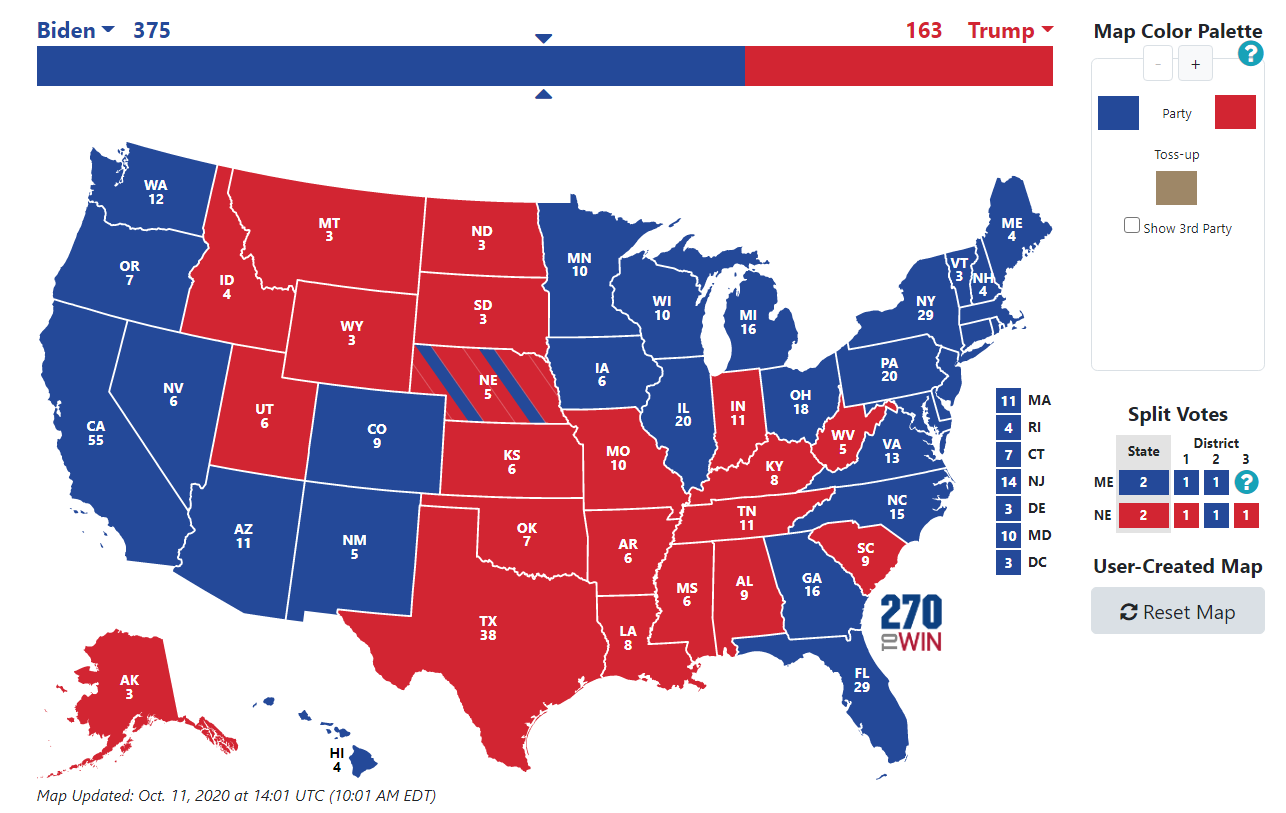
This year, 2020, once again seems poised for a Democratic win.  Based on polling three weeks before the election, we see a prediction for a Biden landslide.

In this scenario, Trump loses Florida, Arizona, Georgia, North Carolina, Ohio, Iowa, Wisconsin, Michigan, and Pennsylvania - all states that he carried in 2016.  This map, I think, is the best case scenario for the Democrats in 2020.

There is an expectation that Trump supporters will once again exceed polling expectations.  There is an undercount, perhaps due to many Trump supporters not participating honestly in polls.  There is also the repeated risk of undercounting pro-Trump turnout due to Trump enthusiasm.

That said, at the risk of being wrong again, I don't think that will be as stark in 2020.  While Biden supporters are not particularly enthusiastic for Biden, they do not have the same level of hostility as they did to the Clinton campaign in 2016. Many liberal voters also regret sitting out 2016 and are not willing to make that mistake again.

Even with a bump for Trump enthusiasm, it is heard to see a path to Trump victory.  A map giving Trump every state where consensus polls show him within 5% of Biden still give a slim electoral victory to Biden.

In this scenario, Biden wins back the critical states of Wisconsin, Michigan, and Pennsylvania, while holding on to every state that Clinton won.  If Trump cannot turn around a 6% or 7% polling deficit in those three states, it is difficult to imagine a path to reelection.


Wednesday, November 9, 2016

Good Morning President-Elect Trump

I am writing this on the morning after election day, before I've had much opportunity to digest what just happened.  All I can say is ... wow!

Unconventional Victory

Donald Trump defied expectations all along the way.  When he announced his candidacy, no one saw him as the ultimate winner.  There is even good evidence that Trump himself never expected to win even the nomination when he first announced.  He simply wanted publicity.

He defied all predictions when he won the Republican nomination over many more credible opponents who had much better traditional credentials.  He managed to defy all conventional wisdom to win the primaries, only to face the conventional wisdom that such a divisive candidate, who could not even unify his own party, could never win the election.

Trump never received the endorsements of most leading Republican politicians.  Those he did get were usually qualified and half-hearted.  All former Republican presidents and presidential candidates boycotted his convention, with the single exception of Robert Dole (who did not even speak a the convention).  Candidate Trump had an ongoing open feud with Republican Speaker Ryan.  Senate Leader McConnell mostly stayed quiet.  Leading conservative pundits supported Clinton, some (like George Will) even quit the party over Trump's nomination.

Trump never got massive contributions, raising only a little over $100 million in individual contributions.  He contributed another $50 million himself.  By comparison, Clinton raised over $350 million in individual contributions.  When you consider outside PACs, Clinton had over $200 million spend on her behalf while Trump had only around $60 billion.  Final numbers are not in yet, so these may shift somewhat.  But it is clear that Clinton outspent Trump by more than 2 to 1.  Once again, this proves that money is not decisive in politics.

I must admit that I personally scoffed and the Trump campaign's inability to work with the RNC, to do professional poll tracking, or to put together any serious "get out the vote" campaign machinery.

Trump continued to remain behind in the polls on election day.  Yet as they received actual voting results, it quickly became clear that Trump was doing much better than expected.  Florida and North Carolina, which had been trending Clinton, went for Trump.  Virginia, which had been solidly Clinton in all polls, almost went for Trump.  Pennsylvania and Wisconsin, which had been solidly pro-Clinton in all polls, did go for Trump.  New Hampshire, Michigan and Minnesota are still too close to call, but it appears Trump may win at least two of those states, which polls all indicated for Clinton.  Minnesota is the only State in the Union to have voted consistently Democratic for forty years.

The question that campaign professionals and pundits will be asking for years is, how did Trump do it?  How did his unconventional campaign lead to victory?

Clinton Could not Unite America

Part of the reason has to be a weak opponent.  Hillary Clinton came out of a divided primary, contested up until the convention.  More importantly though, Clinton has been under attack by the "vast right wing conspiracy" for over thirty years.  Some will argue the attacks are justified, some not, but there is no doubt that the attacks have had their impact on her reputation.  Even many Clinton supporters see her as a deeply-flawed candidate.

More than that though, Trump had the ability to motivate white working-class voters in a way that no presidential candidate has since Ronald Reagan.  I think when we look closer at the numbers, we will see that this demographic turned out in record numbers, blowing away old state by state models for victory.  Personally, I find it ironic that both Reagan and Trump won this group in part based on a message of tax cuts for the rich, meaning the working classes would pay a higher percentage of taxes overall.  That said, they seemed to connect with this group on both an emotional level, as well as a policy level.  Trump's promise to bring back jobs by renegotiating trade deals and expelling immigrants seems to have resonated particularly well in the mid-west, the most important swing-region in modern elections.

October Surprises

Some will credit or blame the victory on October surprises.  This election certainly saw its share of those.  Wikileaks released information about Clinton's speeches to Wall Street, unflattering strategy emails about the campaign, and other information that further soured voters.  Probably most devastating, though, was the ill-timed decision of FBI Director Comey to announce he had re-opened the investigation into Clinton's private email server.  Even though he also announced that he was closing it again a week later, days before the election, it forced the discussion of the final week to be about an issue that had been dragging down Clinton for months.

Trump, of course, overcame October surprises of his own, including the recording where he talked about molesting women, and the numerous women who came forward to confirm his activities.  That seemed to have some impact on his campaign, but clearly not a fatal one.  Once again, Americans had made clear they just don't care if their President sleeps around.

Long Term Trends

It is too early to assess exactly what factors most contributed to Trump's victory.  US voters have consistently rejected leaving either party in office too long.  Since WWII, voters have consistently changed the party in the White House every eight years except one (1980).  If you exclude Presidents who took office following the death of their predecessor, no Democrat has followed a two term Democrat since Martin Van Buren succeeded Andrew Jackson way back in 1837.  Voters like change and Trump was the change candidate.

A Trump Presidency

Democrats are understandably stunned and some terrified at the notion of a Trump presidency.  I say one has to keep these things in perspective.  Historically, much of the country thought the nation was coming to an end when Presidents Jefferson, Jackson, Franklin Roosevelt, and Reagan were elected.  All of those presidencies worked out well for the country.  Many of those presidents did things that the opposition hated, but the nation as a whole continued to grow and thrive.  Presidents have a way of rising to the occasion, even if we did not expect it from their earlier behavior.

Sure, there will be some changes that Democrats don't like.  Obamacare will almost certainly be repealed and replaced with something (I'm not sure what will replace it, but we're told it's going to be just amazing).  There may be some crazy tax cuts for the rich.  In the end though, a powerful and stable democracy like the United States will remain much the same.  President Trump will lead one branch of government.  He still has to work with Congress.  Even though there are Republican majorities in both houses, men like Speaker Ryan will serve as a check on any of President Trump's crazier notions.  A Supreme Court will also hold back any attempted end runs around the Constitution.

I congratulate President-elect Trump on his surprise victory.  May you continue to defy the pundits and have a Presidency worthy of our great country.

Monday, November 7, 2016

How to Watch Election Night

As a political junkie, I look forward to election night the way some people look forward to the World Series.  I stay up all night, watching returns, listening to the commentary and waiting to see when we can predict the final outcome.  Of course, there are lots of sub-plots involving who will win the House, Senate, or various Governors' races.   The big show every four years is the Presidency.

The interesting thing is to see what early States may show the who will win the night.  Sometimes its pretty much over by 8 PM.  Other times it goes well into the night.

Since the 2000 elections, news organizations have been reluctant to make any State predictions prior to the closing of any polls.  Otherwise, they get accused of suppressing voter turnout by declaring a winner before all the voters of a State get a chance to vote.

As a result, most of the evening is filler - commentary from all the talking heads, with all the action happening at the top of the hour when polls close in certain States.  As soon as the polls close, most news organizations will announce the predicted winner, unless it remains too close to call.

If you like to watch the returns come in live, the key is knowing when polls close and what State really matter.  Some states are not an issue.  I could tell you last month, or last year that Clinton would win New Jersey and California, and that Trump would win Texas and Kentucky.  Some States are just a given for one party or another.  Its the swing States that decide who goes over the top.

Popular vote does not matter.  Electoral votes decide the Presidency. Almost all States are "winner take all" meaning the candidate with the most votes get all the electoral votes for any given State. The only two exceptions are Nebraska and Maine, which award one electoral vote for each Congressional District won, plus the two state-wide electoral votes to the State winner overall.

With many States now too close to call, many of the most critical swing states may remain too close to call for hours after the polls close.  Here is what you should be watching though - all times are listed in eastern standard time.

7:00 PM

Polls close in Georgia, South Carolina, Vermont, Virginia, Indiana, Kentucky

South Carolina, Indiana and Kentucky should be easy wins for Trump.

Clinton once thought Georgia was winnable, but not appears strongly Trump.  If Georgia is still too close to call at 7PM, that is very bad news for Trump.

Vermont it the only easy win for Clinton at 7PM

The only interesting State is Virginia, where Clinton is favored by a good five points.  If Trump does well there, or too close to call at 7PM, that is very bad news for Clinton.

7:30 PM

North Carolina, Ohio, and West Virginia close at 7:30.

West Virginia is an easy Trump win.  Ohio seems to be leaning for Trump, with North Carolina also leaning but a little less so.  If Clinton wins either State, a Trump victory is probably impossible.

8:00 PM

Most east coast states close at 8:00.

Connecticut, Delaware, DC, Maryland, Massachusetts, New Jersey, Rhode Island, and Illinois should all be easy Clinton wins.

Tennessee, Alabama, Kansas, Mississippi, Oklahoma, South Dakota, and Texas should all be easy Trump wins.

Michigan is a pretty Clinton-leaning State.  If Michigan is too close to call or going for Trump, Clinton is in real trouble.

New Hampshire also leans Clinton but is much closer.  New Hampshire may be too close to call.  If Clinton wins there, the math starts to get very difficult for Trump.  Clinton is still very much alive though, even if Trump wins there.  The night just becomes more of a nail biter.

Pennsylvania is a State where both candidates campaigned hard.  Clinton seems to have had an edge there for most of the campaign.  I see Pennsylvania as a must-win for Clinton.  If she loses Pennsylvania, she will need to make a great many votes in other toss up States where she is farther behind if she has any chance of winning.

Maine is an easy win for Clinton, but has one Congressional district with an electoral vote that may go for Trump.  Losing that also makes Clinton's math a little harder.

Also closing at 8:00 PM is Florida.  This is by far the biggest swing State.  It will almost certainly be too close to call.  If Clinton wins, there is probably no path for a Trump victory at all.  If Trump wins, Clinton's road to victory looks very rocky.

8:30 PM

Arkansas is the only state closing at 8:30.  Despite the fact that Clinton lived there for years as first lady, it is expected to be an easy Trump win.

9:00 PM

At 9:00 PM most of the remaining eastern and central States close their polls.

New York, home state to both candidates, should be an easy Clinton win.  New Mexico is also pretty reliably Clinton.

Louisiana, Nebraska, Arizona, Kansas South Dakota Texas, and Wyoming should all be easy Trump wins.  Clinton made a push for Arizona at one point, but seems to have given up there.

Michigan, Wisconsin, and Minnesota are both pretty solidly Clinton as well.  But Trump targeted some time in both states for his last few days, hoping for a flip somewhere.  If Trump can take any of these, he could very well pull off a victory.  Expect them to go to Clinton though.

The biggest question mark for the 9:00 hour is Colorado.  This has remained pretty consistently for Clinton in the polls, but never by very much.  Clinton is favored here.  If she wins Colorado, she is likely to win the whole thing.  If Trump has won most of the tossups up until then, Colorado could be Clinton's last stand.

10:00 PM

If the race is still up in the air by 10:00, there are some key States in play.

Montana is an easy win for Trump.  Iowa should be for Trump as well.  That is another must-win for Trump.

Utah is certainly not going to go for Clinton. However, Independent Candidate Evan McMullin has been polling very well there.  He could possibly deny those electoral votes to Trump, which could make it nearly impossible for Trump to reach the 270 majority.

Nevada is the biggest bell weather at 10:00.  It is leaning for Trump and is another State he really needs if he wants to remain in the fight.  Trump will likely win, but a Clinton upset there could be the final nail in Trump's coffin.

11:00 PM

Until 11:00, Trump will likely lead in all electoral vote counts.

At 11:00 he will also pick up wins in North Dakota, and Idaho.

However, Clinton's numbers will surge with what should be easy wins in Oregon, Washington, Hawaii, and the giant: California.

None of these States are in serious contention.

1:00 AM

Finally, polls close in Alaska at 1:00 AM eastern time.  Trump will almost certainly win there, but by then no one will care.  The election should be over.  If Alaska's three electoral votes would make the difference, Trump will be President.

My Predictions:

In my opinion, this race has come down to four States: Florida, North Carolina, New Hampshire, and Nevada.  These are the States that I think are most up in the air.  If Clinton wins any one of them, she should become President.  Trump must either win all four, or pull an upset somewhere like Pennsylvania, Michigan, or Colorado.  I predict Trump may win Nevada, but will lose narrowly in New Hampshire Florida and North Carolina.  As a result, we will see a comfortable electoral Clinton victory:


Thursday, November 3, 2016

Will Colorado Decide the Election?

The late announcement that the FBI has reopened the investigation into Clinton's emails has focused attention for the last week on that subject.  As a result, Clinton's seemingly insurmountable lead over Trump has dwindled.

Clinton still seems to hold an electoral advantage.  As I've pointed out in several recent posts, Trump has to win not only all of the toss up States, but also at least one decently sized State that has been leaning Clinton in order to win.

As I see it, the toss up States are, in order of size:

Florida
Ohio
North Carolina
Nevada
Iowa

Now I know that some prediction sites have a larger "toss up" list, but at this point, I think Pennsylvania, Virginia, Wisconsin, Colorado and New Hampshire are going to go Clinton.  Each of them have consistently shown Clinton leads in all polls, usually outside the margin of error. Similarly, Georgia, Arizona, and Utah are going to go for Trump (with the possible exception that Utah goes for Evan McMullan.  Clinton made a few ties in those States when riding high, but her recent fall has made them likely red States.

Assuming, therefore, that it comes down to the five States I've listed as real toss ups, Clinton wins. Clinton can lose Florida, Ohio, North Carolina, Nevada, and Ohio and still win.  That's the good news for Clinton.  The good news for Trump is that he seems to have the edge in all five of those States. He could very well take all of them.  North Carolina seems to be his most tenuous advantage at the moment, and could go for Clinton.  But for the sake of argument, let's say Trump sweeps all of them.

A Trump victory, therefore, requires that he also win all those tossups, plus at least one state that I just said was still leaning Clinton.   Pennsylvania and Virginia have throughout the campaign shown Clinton with at least a 3-5 point advantage.  Some polls have been close, but have never swung Trump's way.  I don't see either of those as a good option for him.  Similarly, Wisconsin is pretty consistently showing Clinton with a 5 point lead.  That leaves us with New Hampshire and Colorado.  New Hampshire has one poll showing a Trump one point lead, but all other polls in the last week show Clinton ahead by at least three points.

Colorado though, seems to remain just barely out of Trump's reach. Clinton maintains a pretty consistent 1-3 point advantage in most polls.  If Trump can overcome that advantage, and sweep the rest of the toss-ups, he has 275 electoral votes (270 needed to win).  Another path if he loses Colorado is to win New Hampshire and one Congressional district in Maine, getting Trump to 270. Those are really the only two scenarios for Trump to win.

By contrast, Clinton has many paths to victory simply by winning any of the five tossups I mentioned (and all really could still go either way) to have a margin for error.  But again, even if she loses all five tossups, she need only hang on where she has remained consistently, albeit slightly, in the lead.

Trump does seem to have momentum.  On the other hand, he also does not have any get out the vote campaigns set up. That can easily cost a candidate 1-2 points, possibly more where there is early voting and get out the vote people have longer to work.

It continues to look as if Clinton will win, but every day I seem to say that with a little less certainty.